


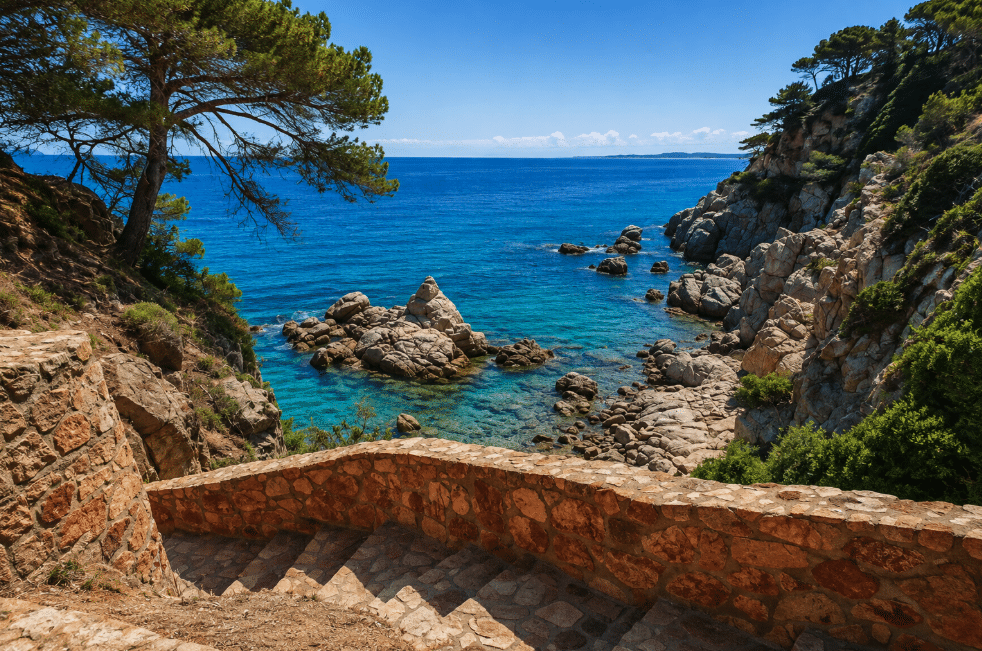
The Camí de Ronda north of Palamós is one of the best ways to understand why this town works so well as a Costa Brava base. Within a relatively short walk you move from La Fosca’s sandy bay to the fishermen’s houses of S’Alguer, the open landscape behind Platja de Castell and, if you continue, smaller rocky coves such as Cala Estreta. You do not need to complete the longest version for the walk to feel worthwhile. Choosing the right section for the heat, the group and the time available is far more important than collecting kilometres.
La Fosca to S’Alguer is the easy introduction
Start at La Fosca if you want a gentle first section. The path quickly leaves the normal beach setting and approaches S’Alguer, a tiny historic settlement where white fishermen’s houses with coloured doors sit almost directly on the shore. The distance is manageable enough to combine with a swim or breakfast, and it gives families a taste of the coastal path without committing to a full hiking day. If the main goal is simply a beautiful walk and a relaxed morning, turning back from S’Alguer is perfectly reasonable.
Continue to Platja de Castell for the biggest change of scenery
Beyond S’Alguer the route opens towards Platja de Castell. This is where the walk starts feeling less like a path between neighbourhoods and more like the undeveloped Costa Brava. Fields and woodland sit behind the broad beach and there is much less urban distraction. Castell is a natural place to stop for a proper swim, eat something you brought with you and decide whether the group wants more. Our Palamós beach guide is useful if you want to compare Castell with La Fosca before choosing where to spend most of the morning.
Cala Estreta is a different kind of outing
Past Castell, facilities disappear and the path becomes rougher. Cala Estreta and the nearby inlets are the part we would save for walkers who actually enjoy the walking. Proper footwear, water and sun protection matter more here, especially in July and August. The route is not technically extreme, but the heat and repeated rises and drops add up. With small children, Castell is often a better turnaround point. With older children or active adults, reaching a quieter cove and swimming there can be one of the most memorable mornings of the holiday.
Walk early in summer and leave space for a swim
In high summer we would start early rather than attempting the exposed sections around midday. The light is better, parking around the popular starting points is easier and the walk feels completely different before the heat builds. Do not schedule lunch so tightly that every stop becomes a problem. The pleasure of this route is being able to sit above the water, swim when a cove looks inviting and continue only when everyone wants to. A coastal path is more enjoyable when it does not turn into a race back to the car.
The nicest finish is back in Palamós
The contrast is what makes this walk special. You can spend several hours among pine trees, rocky coves and quiet coastline, then return to Palamós for a late lunch or an evening around the harbour. That connection between nature and town means the Camí de Ronda does not feel like a separate excursion. If you are deciding whether Palamós is the right base for an active family, our Palamós with children guide shows how this walk can fit into a wider holiday without making every day strenuous.
Stay close to Palamós and the coastal path
Explore our holiday homes in Palamós and make the coastline part of the holiday rather than a separate day trip.